Anselm Kiefer
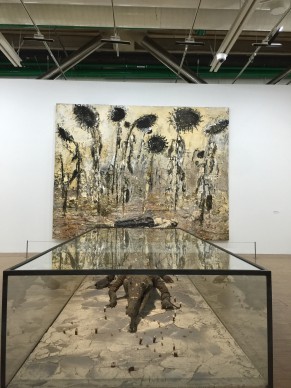
By Anselm Kiefer
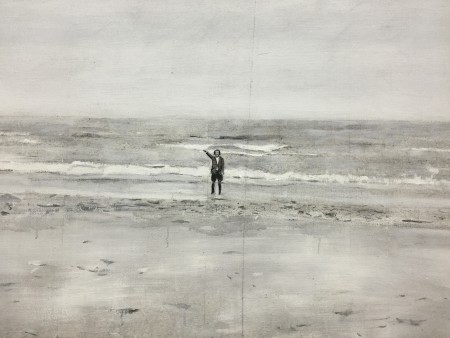
By Anselm Kiefer
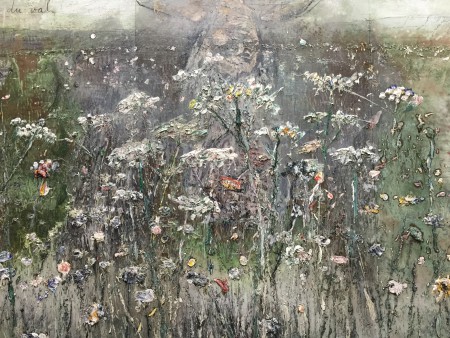
By Anselm Kiefer
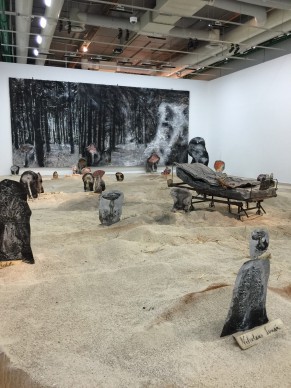
By Anselm Kiefer
Anselm Kiefer
By Anselm Kiefer
With a retrospective, you’re telling your story?
Just showing a few traces of my story. My story doesn’t begin in 1945. It goes back to the time of the dinosaurs. You know, within your body you have cells that were conceived at the time of the dinosaurs. Brain specialists are saying this. And so, if you’re jealous, this doubtlessly comes from the time of the dinosaurs. It’s a primitive feeling.
How can you know that jealousy comes from this era?
I’m only saying that such an idiotic feeling cannot be human. Let’s say I wish this were a feeling that isn’t human.
Your practice is steeped in scholarship. Do you wonder how it’s being understood by the public?
I’m not asking viewers to have the same culture I have. People can come here without having any notion about questions of philosophy, alchemy or history. All they have to do is look. I’m not asking people to study what I have studied. That would be idiotic. I’m asking them to open themselves up to the painting by focusing in such a way that they leave anything that might bother them outside. It’s for this reason, for instance, that I refuse to have my paintings exhibited at art fairs. There’s too much interference in these types of contexts. You should always put a painting in a situation where it can bloom.
In your view, are your painting blooming at the Centre Pompidou?
Yes, I hope so. At my place in Croissy [his studio in the Seine-et-Marne region], I prepared the show’s hanging with life-size models and reproductions of the works at their actual size.
Your body of work permeated by a dark tinge. Are you pessimistic?
What? My art? Why “pessimistic’? I am not pessimistic. I am cynical. I see that the world is ill conceived. You know, after the Second World War, people thought that because Hitler was dead a new period was beginning. We can say that it wasn’t the case. It goes on: atrocities, nationalism. Men are ill conceived.
And do you think you were ill conceived yourself? Are you trying to correct yourself?
Yes. One of my attempts at betterment was my gesture of salute. [In 1970, Kiefer repeated the Nazi salute clad in his father’s German army clothes.] Because I really wanted to know whether, at that time, I would have really participated or not.
On this occasion, you had put on your father’s clothes on. It’s highly symbolic. Did you get along well with him?
No, not at all. But that’s another subject. The fact that the uniform belonged to my father is of no importance. I could have bought one at the flea market.
Was this act a foundational gesture for you?
Yes, because it was the first time I began to gain some knowledge about myself. My intimacy relating to recent history. Later, I explored further back, to Mesopotamia and even the dinosaurs. [Laughs.]
In our last interview you me that, as a child, you wished to become Jesus Christ.
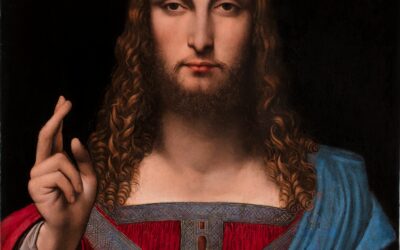
Yes, that’s true. You know, I come from a very Catholic family. Out of my grandfather’s fourteen children, thirteen were priests, monks and nuns. I wanted to become someone who represented the apex of my world at the time.
Do you have boundless ambition?
No, I just wanted to follow my idol.
But you didn’t want to become one of the Beatles like kids did at the times but, rather, Jesus.
I was no more than five years old. The Beatles didn’t exist. Later on, I dreamed of being the Pope.
Well, this certainly shows your level of ambition.
When you get older, you understand that titles, idols—that all this is relative.
Do you think you’re an idol today?
No. Today my objective isn’t to be the greatest painter. And anyway, history is the one deciding, not us.
But you like the idea of the grandiose. Even your paintings are very big.
Not especially. My paintings aren’t big. [He’s speaking about 4-meter-long [13-foot-long] paintings.] Go to the Louvre. You’ll find canvases that are even bigger than these there. These works here are at my measure, at my physical scale. The size of a painting isn’t important. Look at Willem de Kooning’s “Havana Paintings.” [The American painter created Suburb in Havana in 1958, among others.) They’re 1.5 meters by 1.5 meters [4 feet x 4 feet]. Yet they’re monumental works.
Your works are largely inspired by literature. When do you read?
I read very early in the morning. Do you also want to know what I have for breakfast? [Laughs.] I have a very large library. I walk through it in the morning when I’m not completely awake yet. I take a book, which I select from its spine. And it’s almost always the right one.
The majority of your canvases are dark. What is the importance of color for you?
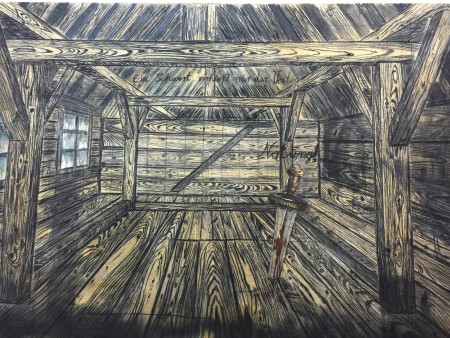
All my paintings begin with color. But sometimes I bury color with ash, with sand. In the exhibition you can see paintings with color in them.
Precisely how do you begin a painting?
It depends. Usually I begin a painting without having any knowledge of what I want to do. Matter is what guides me. After a few hours or a few days I place myself in front of the canvas and I ask the painting what it is telling me. What follows is an intellectual process.
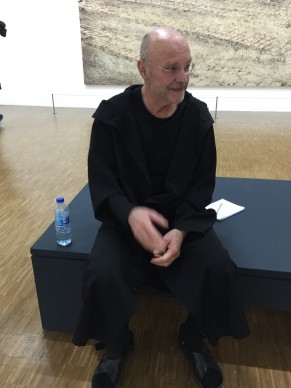
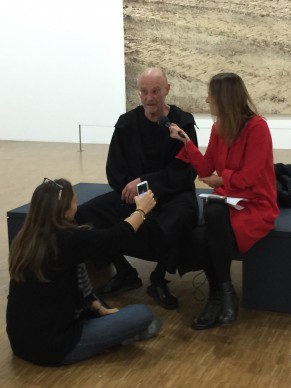
Kiefer get up to leave. It’s very cold this December in Paris, yet he’s wearing sandals with wool socks.
Aren’t your feet cold?
No, not at all. But you’re asking me really interesting questions.
Support independent art journalist
If you value Judith Benhamou Reports, consider supporting our work. Your contribution keeps JB Reports independent and ad-free.
Choose a monthly or one-time donation — even a small amount makes a difference.
You can cancel a recurring donation at any time.
Anselm Kiefer
By Anselm Kiefer
By Anselm Kiefer
By Anselm Kiefer
By Anselm Kiefer
Anselm Kiefer