












National portrait gallery
There’s no better institution than the National Portrait Gallery in London to host a Francis Bacon (1909–1992) exhibition. Firstly, because this extraordinary painter is—alongside Lucian Freud—one of the great luminaries of contemporary British art. And though he was born in Ireland, Bacon settled in London at the age of 16.
New human form
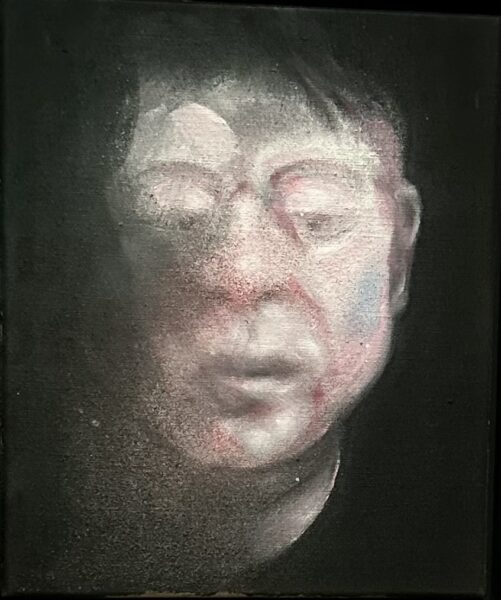
But most importantly, the Portrait Gallery is fitting because through his art Bacon invented a new way of representing the human form through its distortion.
Made up of fifty or so thoughtfully selected paintings paired with extensive documentation, the show offers an unprecedented analysis of Bacon’s expressivity as well as the keys to understanding his inventive genius.
Like a snail
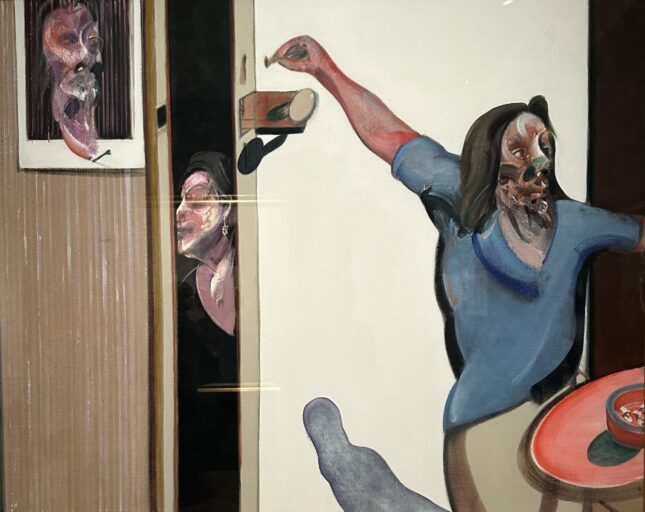
It opens with a revealing quote: “I would like my picture to look as if a human being had passed between them, like a snail, leaving a trail of the human presence […] as a snail leaves its slime.” The results are twisted bodies teetering on the edge of disintegration; mutant existences.
Innocent X
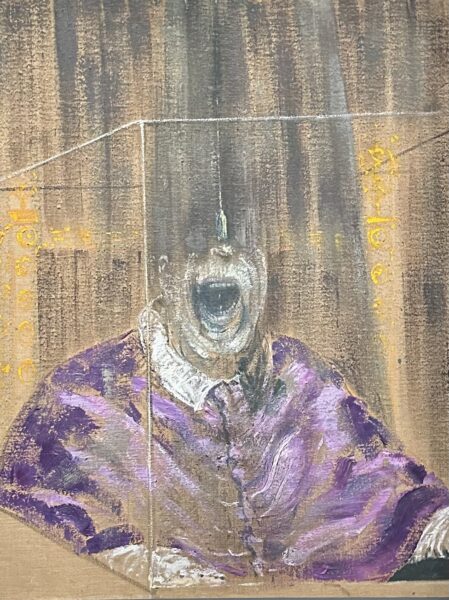
One can, for instance, follow Bacon’s evolving treatment of one of his greatest inspirations: Diego Velázquez’s 1650 portrait of Pope Innocent X. In 1949, Bacon “customized” it in his own style: the clergyman’s gaping mouth appears to be screaming, revealing his large teeth, while the upper face is consumed by a gray force. By 1981, the pope’s short purple cape reappears, but his face is distorted as though viewed through a warped mirror.
Rosie Broadley
“He sought to reveal what was behind the mask,” explains Rosie Broadley, the exhibition’s curator.
Bacon never allowed himself to see the original Velázquez painting in Rome. More broadly, he often worked from photographs, favoring them over live models, even when painting his friends.
Like the Cubists
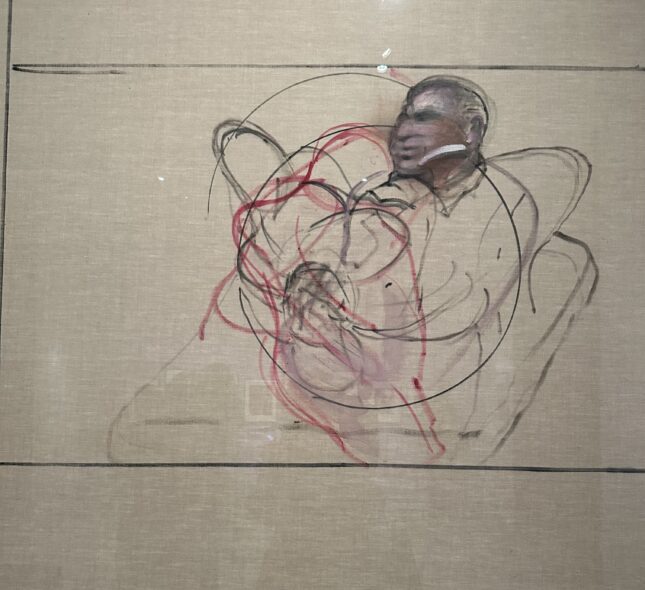
A highlight of the exhibition reveals his method: an unfinished self-portrait left on his easel at his death. The canvas is marked with powerful lines tracing the movements of the head. Like the Cubists, Bacon tended to to depict his subjects from multiple angles, overlaid with the imprint of an inner turmoil.
Dorian Gray
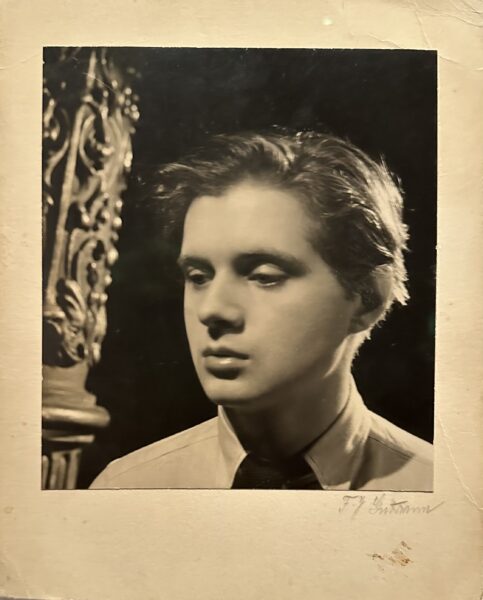
It is striking to see, like a real-life Picture of Dorian Gray, Bacon’s once-youthful, handsome face losing its symmetry, warping over the years in paintings that now appear eerily prophetic. The “snail’s trail” had indeed done its work.
Lucian Freud, Frank Auerbach
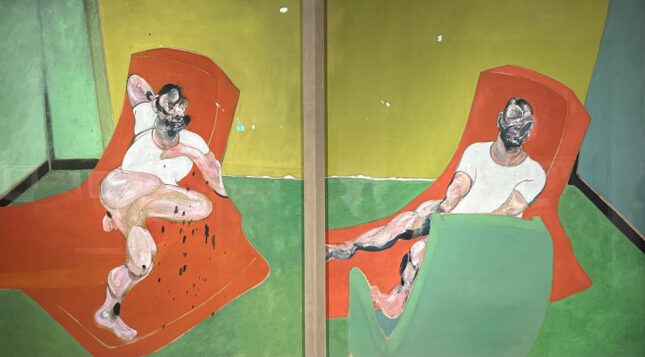
Among the most striking paintings in the exhibition is a 1964 double portrait of his friends and fellow artists Lucian Freud and Frank Auerbach, the latter of whom died on November 11, 2024. Each man is sitting in a large orange armchair and dressed in a white T-shirt, against a background of grass-green carpeting and chartreuse walls.
Injury in private
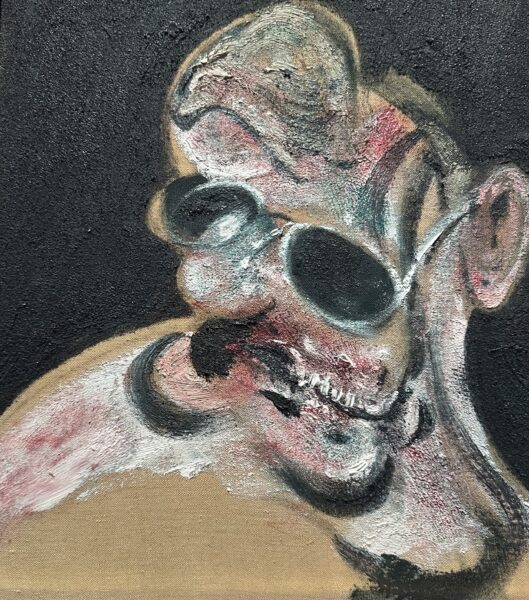
Once again, neither artist sat for the portrait. As Bacon once commented: “If I like them, I don’t want to practice before them the injury that I do to them in my work. I would rather practice the injury in private.”
17 portraits of Freud
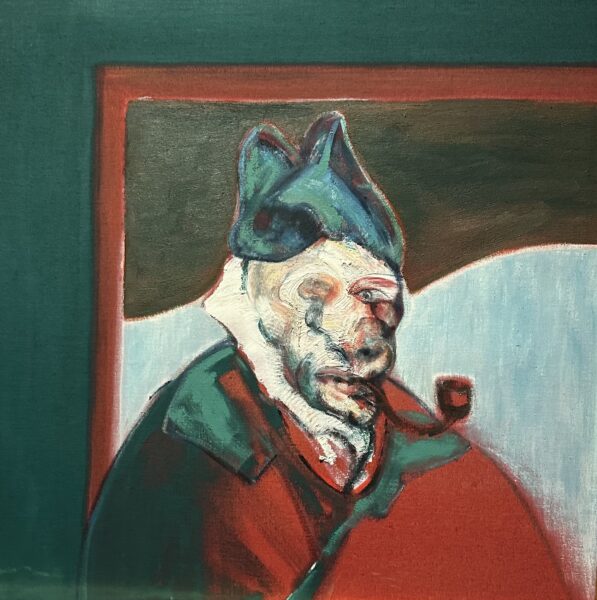
Between 1951 and 1973, Bacon completed 17 portraits of Freud, often using photographs as his starting point. As Tanya Bentley explains in the exhibition catalog, Bacon often incorporated personal details into portraits of others. “The ease with which Bacon interchanged and conflated their body parts in the portraits alludes to the intertwined nature of their relationship at this point in their friendship.”
Lie and reality
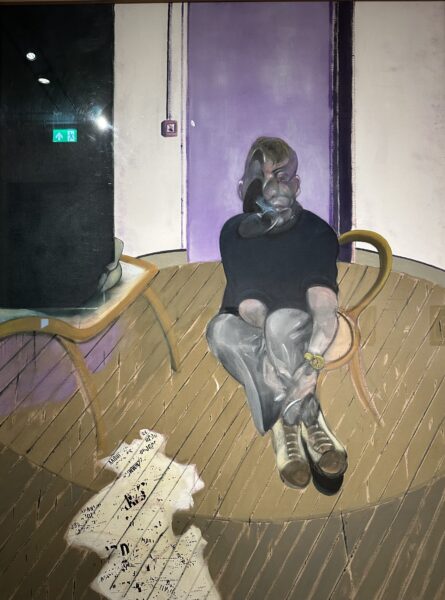
Freud himself noted: “Bacon almost always gave me his legs when he painted me.” Reciprocally, Bacon injected features of Freud into his own self-portraits.
One could conclude with a Bacon quote referencing another illustrious artist he portrayed: “Van Gogh got very close to the real thing about art when he said: ‘What I do may be a lie… but it conveys reality more accurately.’”
Support independent art journalist
If you value Judith Benhamou Reports, consider supporting our work. Your contribution keeps JB Reports independent and ad-free.
Choose a monthly or one-time donation — even a small amount makes a difference.
You can cancel a recurring donation at any time.