
Giovanni Bellini

Giovanni Bellini
Andrea Mantegna
Andrea Mantegna

Giovanni Bellini
Giovanni Bellini
This is, quite simply, because these collections constitute a great currency of exchange.
But it’s also because they naturally attract the most knowledgeable curators (although the authenticity of the artworks remains a delicate matter; see the overly restored Leonardo da Vinci sold last year for 450 million dollars, which has yet to be exhibited at the Louvre Abu Dhabi).
And because they can collaborate with their foreign counterparts who have equally remarkable stockpiles of artworks. The National Gallery in London illustrates this perfectly through their extraordinary exhibition dedicated to Andrea Mantegna (1430/31-1506) and Giovanni Bellini (active between around 1459-1516), two major Old Masters of the Italian Renaissance, organized in collaboration with the Staatliche Museen zu Berlin.
“Exhibitions dedicated to 15th century art are rare because the works are often fragile and don’t travel well,” explains Caroline Campbell, the curator of the exhibition.
But the exhibition at the National Gallery has managed to assemble 90 works by the two painters.
Alexander Roestel, Simon Sainsbury Curatorial Fellow at the National Gallery, explains the idea behind the exhibition.
The legacy of these pioneers of painting is immense and had a major impact on those who followed, from Dürer to Poussin via Titian.
Mantegna worked mainly in Mantua at the court of the Duke of Gonzaga, whereas Bellini flourished in cosmopolitan Venice.
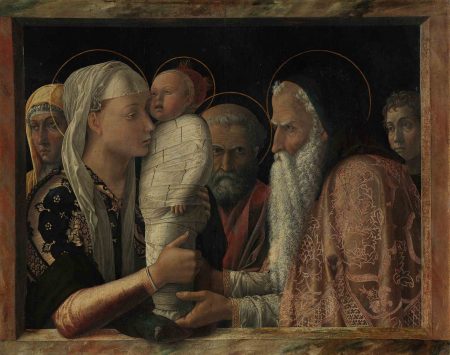
In 1453, Andrea married Giovanni’s half-sister and the son of a carpenter thus entered into one of the largest families of painters of the time. This evidently resulted in both emulation and admiration, illustrated from the beginning of the exhibition by the juxtaposition of two key paintings.
The first, “Presentation at the Temple”, which depicts a scene with a mother with a pure countenance holding up her swaddled child, surrounded by a group of dignitaries all seen in half-length portrait, was painted by Mantegna in around 1454 using the egg tempera technique (1).
It was only in around 1470 that Bellini reproduced the composition identically, executing a more modern version using oil paints and simplifying certain details to create a masterpiece of theatricality.
In both paintings the background is monochrome. The first belongs to the Gemaldegalerie in Berlin; the second to the Querini-Stampalia foundation in Venice, where it is the star painting.
The exhibition plays a fascinating kind of pictorial ping-pong.
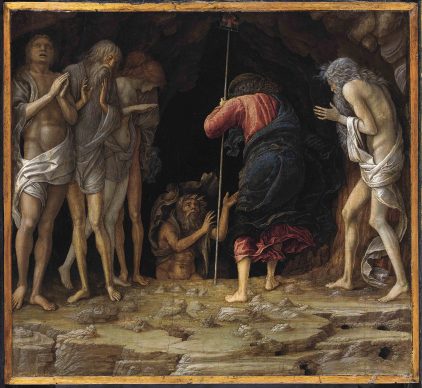
The subject of Christ’s Descent into Limbo long preoccupied these painters. How do you depict the passage into the realm of dead souls?
Mantegna’s version, showing a group of skeletal men draped in cloth, was sold for the record price of 28.5 million dollars in 2003.
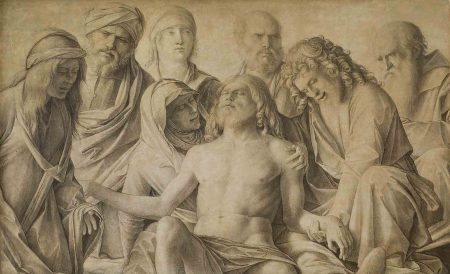
In Bellini’s the helpless figures are naked and distraught.
Mantegna liked painting landscapes, to the point of even bringing his trees to life. In his “Minerva expelling the Vices from the Garden of Virtue”, the cypress tree on the left-hand side has a head, eyes and two arms, like a surrealist creation. Bellini was not indifferent to power and we will long remember the portrait of the icy and stiff Doge Loredan, whom he succeeded in humanizing thanks to a sublime bluish-grey background and a slight pout around the hard lines of his mouth.
In what might be called the sublime necklace of the history of art, where each major painter through their work adds another pearl to the string which contributes to the piece of jewellery as a whole, the genius free-thinking art historian Federico Zeri declared in his essay “Renaissance and pseudo Renaissance” (1) that there were the major artists, which included Mantegna and Bellini, and those who were more incidental: “Bellini integrated essential elements of the art of Donatello and Andrea Mantegna (…) which gave rise during the last decade of the 15th century to the unique phenomenon that was Giorgione (…) The Venetians through Titian launched the notion of painting understood in terms of material and colour, which led to Goya, the impressionists and the dissolution of the closed form”.
This is how the history of art shapes and reshapes itself. The National Gallery immerses us in a few years of this fabulous episode.
Until 27 January. www.nationalgallery.org.uk
(1) Renaissance et pseudo Renaissance, Editions Rivage. 1985.
Support independent art journalist
If you value Judith Benhamou Reports, consider supporting our work. Your contribution keeps JB Reports independent and ad-free.
Choose a monthly or one-time donation — even a small amount makes a difference.
You can cancel a recurring donation at any time.
Giovanni Bellini
Giovanni Bellini
Andrea Mantegna
Andrea Mantegna
Giovanni Bellini