












A Brazilian woman
Regardless of the strength of her talent, this painter exhibited at least two handicaps for her time: she was a woman – the weaker sex in art – and Brazilian, therefore far removed from the Parisian artistic epicentre.
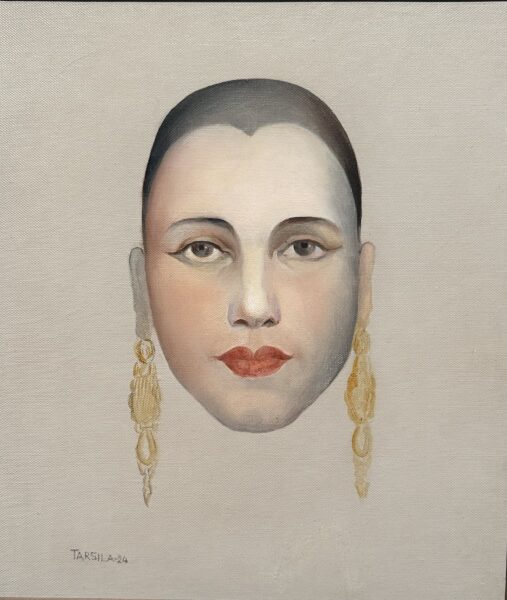
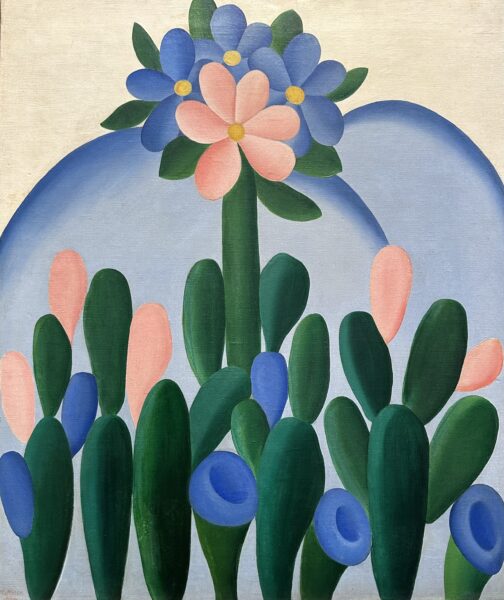
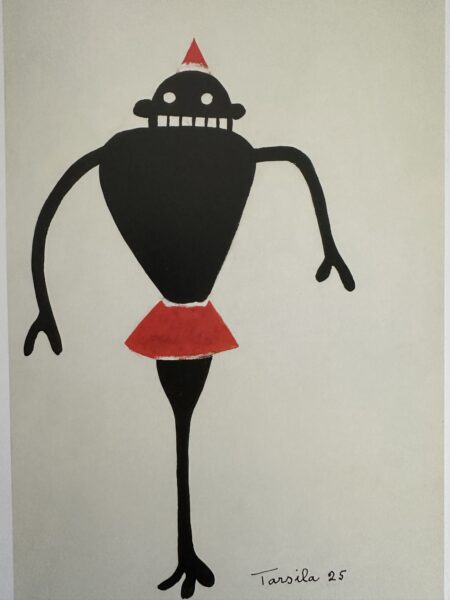
However Tarsila do Amaral (1886-1973), who for a time was a student of Fernand Léger in Paris, among others, invented an absolutely unique visual vocabulary in the 1920s that could be described as resembling simultaneously cubism, surrealism, Georgia O’Keeffe and contemporary animation drawings.
Beautiful retrospective
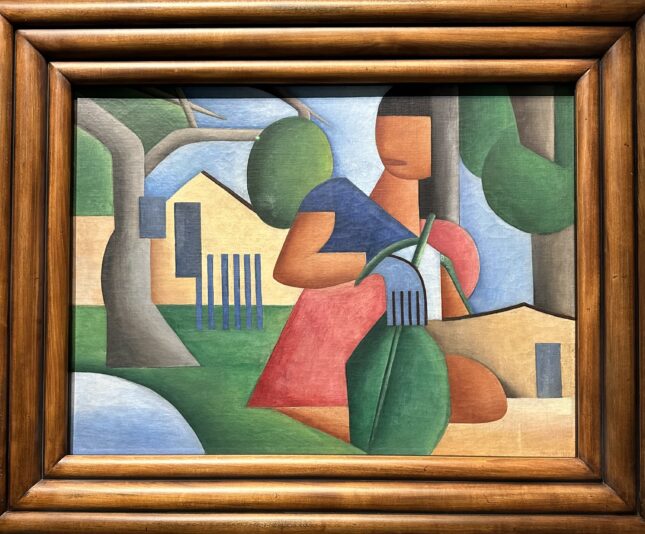
But unlike another Latin American artist with a similar profile, Frida Kahlo, the fact that she didn’t develop her own cult of personality would confine her, in terms of celebrity, to Brazil. Yet her work is important, as we can see in the very beautiful retrospective at the Musée du Luxembourg in Paris until February 2. In 2018 Moma in New York dedicated an exhibition to her which gave her an initial international response. (see here a report about it). Her work is also featured in Adriano Pedrosa’s exhibition at the Venice Biennale, which runs until November 2024.
Cecilia Braschi
Because it’s almost complete, the Luxembourg exhibition, which is also travelling to the Guggenheim Bilbao, will most likely restore her place within modern chronology on this side of the world. Tarsila’s body of work is relatively small, containing only around 200 works according to exhibition curator Cecilia Braschi. 43 are in Paris.
“The Negress”
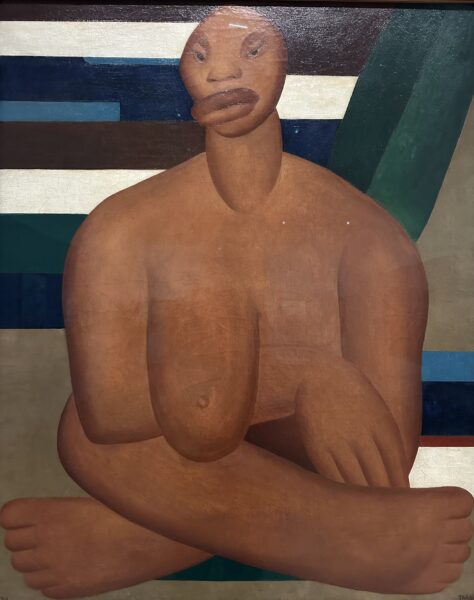
One of her most exuberant paintings is missing, “Abaporu” from 1928, depicting a figure as seen through a distorting mirror with enormous feet and legs, which has not made the trip from the Argentinian public collections where it is housed. But in the same spirit there is “The Negress” from 1923 depicting Tarsila’s nanny, a former slave – slavery was only abolished in Brazil in 1888 – an archetype of the nurturing mother with enormous breasts.
Arte Negra
“There are different readings of this work,” explains Cecilia Braschi. “Amaral, from an upper middle class family, was not really familiar with what life was like for black Brazilians in her country. This image resembles what was then called ‘arte negra’.
Blaise Cendrars, Oswalde de Andrade
Also at the time she was very close to someone like the author of the ‘Anthologie Nègre’, Blaise Cendrars. It was therefore a depiction made for a typically Western audience.” In her country the painter was part of an intellectual movement, the Grupo dos Cinco (group of five) – which included her husband at the time, the poet Oswald de Andrade – who sought to give a purely Brazilian character to their creation by featuring a black and Indian presence.
Inventing a landscape
Tarsila do Amaral.
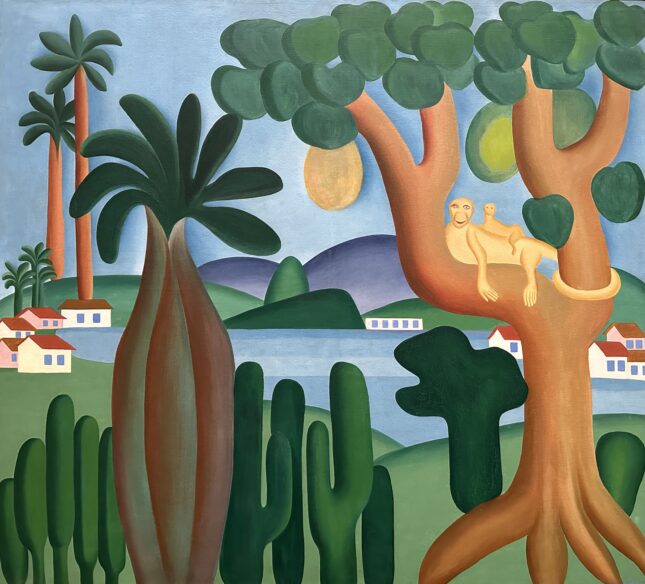
This is the case with her compositions, which are often marked by cacti and palm trees.
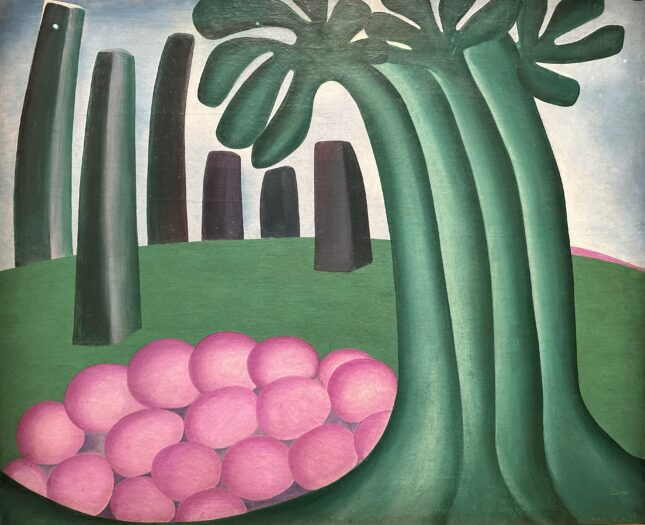
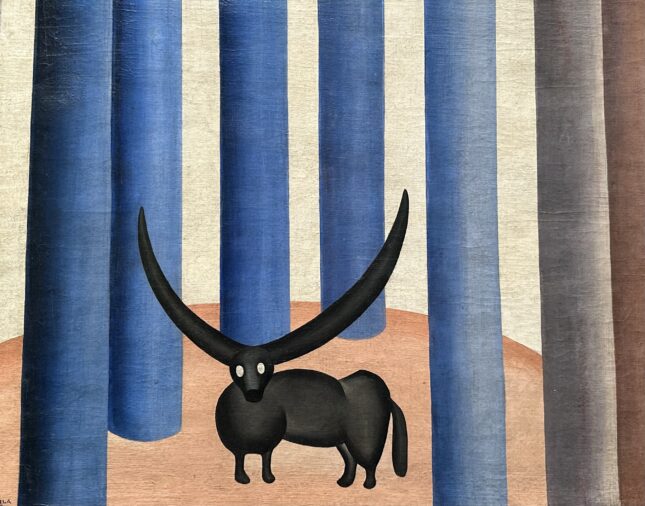
In “Postcard” from 1929 Amaral invented a new landscape: the countryside is represented in layers with fantastical fauna in the foreground, just like in “La Cuca” from 1924 – the only painting in French collections – which depicts a strange animal, especially strange given that it’s invented, inspired by indigenous stories.
Communist spirit
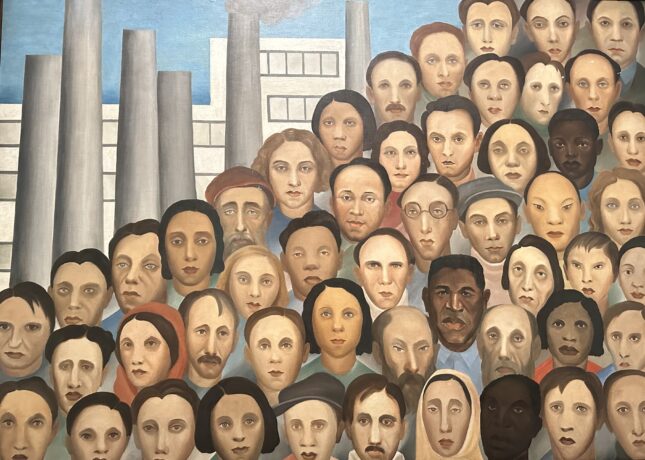
In the 1930s she practised art in a very militant communist spirit. See her “Workers”, showing multi-racial faces that make up a pyramid. Her final stage, revealed for the first time at the Musée du Luxembourg, consists of stretched figures that merge with the undulating landscapes, as in the painting she titled “Earth” from 1943, which likely alludes to the rural workers’ struggles at the time.
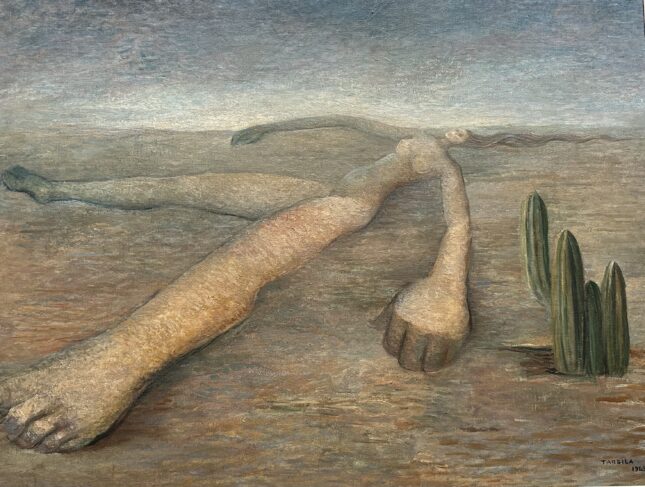
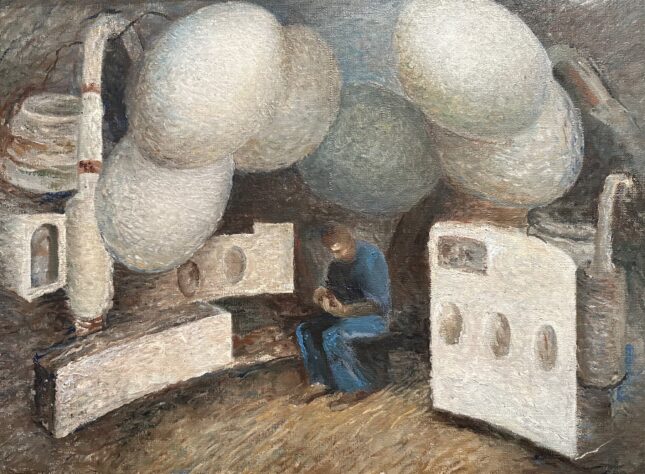
We must admit that the last phase of Tarsila’s work, after the war, is clearly less inventive. Urban landscapes with skyscrapers, geometric and colourful country representations… A relatively graceful kind of painting but devoid of the revolutionary spirit of the 1920s.
Until 2 February
https://museeduluxembourg.fr/fr/agenda/evenement/tarsila-do-amaral
Support independent art journalist
If you value Judith Benhamou Reports, consider supporting our work. Your contribution keeps JB Reports independent and ad-free.
Choose a monthly or one-time donation — even a small amount makes a difference.
You can cancel a recurring donation at any time.