












All about intimacy
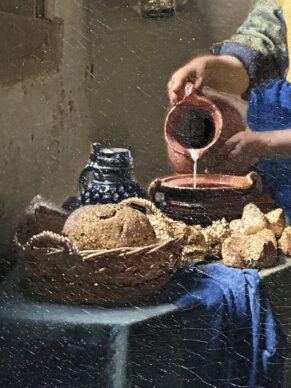
Talking about the great Dutch painter Vermeer (1632-1675) in terms of numerical data seems like a misinterpretation. This art legend, all delicacy and detail, known for his descriptions of 17th-century interiors from the city of Delft, famous for his skilful freezeframe paintings, a figure reading a letter, the motion of a woman pouring milk, another dozing or playing the harpsichord, are above all about intimacy.
Numbers about a retrospective
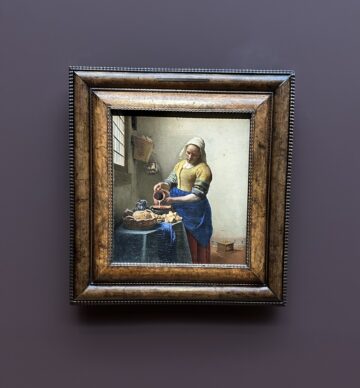
At a time when artists were drawn to gods and churches, he almost always worked on human minutiae, sensitivity and grace. And yet it is primarily numbers that define his new retrospective, which looks set to be a blockbuster, on display at the Rijksmuseum in Amsterdam until 4 June (1). Firstly, the paintings that are recognizably from the hand of Vermeer: there are 37 of them today, according to the Dutch institution, the number fluctuating according to the era, the body of knowledge, scientific advances, and the often opposing expert opinions. The latest discovery is “Young woman seated at a virginal” (included in the Amsterdam exhibition) which belongs to the Leiden collection of the American businessman Thomas Kaplan (see the report on the Leiden collection here and here).
28 paintings exhibited
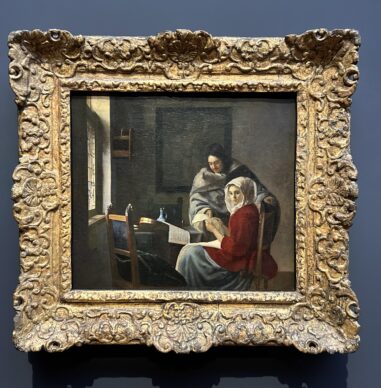
Then there are those exhibited in Amsterdam: 28 paintings are displayed in ten vast rooms that have been remarkably staged by the French architect, Jean-Michel Wilmotte. That is to say, the show is a great achievement. Never in living memory, which as it happens is rather short, has such an assembly of paintings by the artist existed.
Rediscovered in 19th century
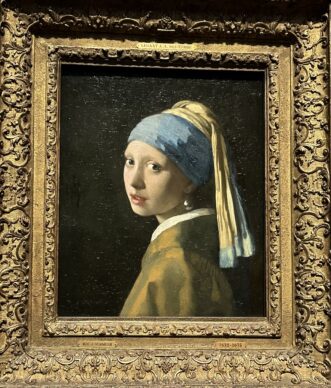
It must be said that Vermeer was only rediscovered and publicized in the latter part of the 19th century, having fallen into obscurity in the history of art. It was a French historian, Théophile Thoré (1807-1869), who during a period of enforced exile in Holland, after the 1848 revolution, rediscovered everything about him, even his family name. The oversight is justified, among other things, by the fact that the paintings were primarily in the possession of private individuals.
Painting like a hobby
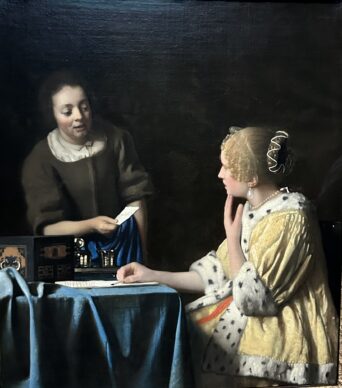
And if the corpus of his oeuvre is so slight – he produced 45 works maximum, which is not a lot compared to Rembrandt’s 350 – it is because the artistic practice was, for Vermeer, just a hobby for a time. To feed his large brood of 11 children he was, among other things, a picture dealer and civil guard, as the curator of the exhibition Pieter Roelofs says.
Pieter Roelofs
“There is a striking contrast between the calm of his compositions and his activity as a militiaman for the city of Delft, then the tragedy of his life after 1672. Vermeer initially had some success, and a French visitor to Delft even talks about the ‘famous Vermeer’ during his lifetime. That is, until 1672 when Holland was invaded by Germany, France and England. Then he fell into despair, and no longer sold his paintings or those of others. He was debt-ridden, according to his wife.”
Influenced by the Jesuits
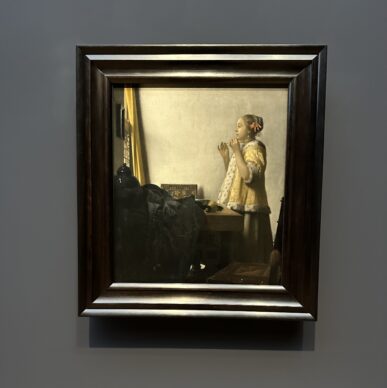
Vermeer deliberately overlooked numbers to let the beauty in his canvases sing. He disturbs the gaze while meticulously working on optical effects. He plays with shadows, with principles of perspective, uses the black box called the camera obscura to reproduce reality. In this he must have been influenced by the Jesuits based near his home. “The major recent discovery is how important Catholicism was in his creation,” comments Pieter Roelofs. “The Jesuits advocated for the use of the camera obscura to illuminate souls. He made it a tool for the representation of light and colour.”
The great Little street
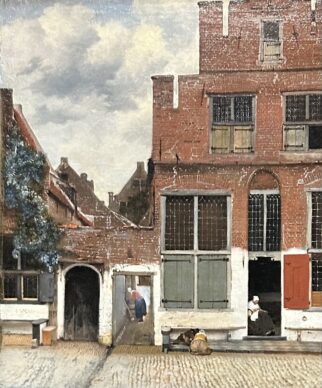
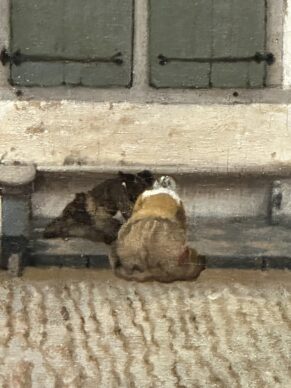
The exhibition opens with “The Little Street”, one of his two outdoor scenes, an urban composition with an extreme sophistication that includes several paintings within the painting. It is the fruit of a complex geometric construction, composed of juxtaposed planes. It illustrates well the feeling that consumes the visitor on leaving the exhibition.
“Vermeer worked intensely with his subjects to produce paintings that seem simple” concludes Taco Dibbits the director of the Rijksmuseum.
In Amsterdam, this exceptional display allows us to understand how close the spirit of Vermeer is to that of the 21st-century viewer.
Until 4 June. Vermeer. Rijksmuseum
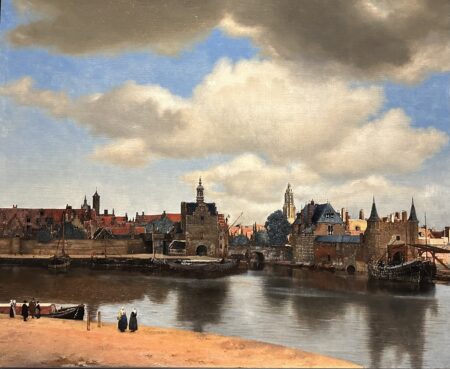
(1) The last one took place in 1996 in Rotterdam (with 22 paintings) and Washington. In 2017 the Louvre also displayed 12 Vermeers in “Vermeer and the Masters of Genre Painting”. See the report about the Louvre show here.
Support independent art journalist
If you value Judith Benhamou Reports, consider supporting our work. Your contribution keeps JB Reports independent and ad-free.
Choose a monthly or one-time donation — even a small amount makes a difference.
You can cancel a recurring donation at any time.